

Texas real estate is entering a period that will reward clear-eyed decision-making.
The Texas outlook remains supported by the things that have made the state durable for years: a large and diverse economy, ongoing population growth, and demand for places to live and do business. But beneath that broad strength, commercial real estate is working through a very different issue: debt that was cheap a few years ago is now coming due in a far more expensive lending environment.
That does not mean every property is in trouble. It does mean that the next chapter will be less about the easy appreciation of the ultra-low-rate years and more about fundamentals, financing, and discipline.
A Constructive Texas Outlook — With Assumptions
The Texas Real Estate Research Center at Texas A&M University’s forecast through summer 2027 starts from an important premise: absent a new macroeconomic or geopolitical shock, Texas remains positioned for continued economic activity over the next year.
That is a useful backdrop, but it is not a blank check. A statewide forecast describes direction; individual markets and properties still live or die by local job growth, supply, rents, expenses, and the terms of their debt.
For homeowners, that means decisions should remain personal and practical. The right time to buy or sell depends on your payment, timeline, equity, and the specific neighborhood—not simply a headline about Texas as a whole.
For investors and commercial owners, it means the quality of the asset and the capital stack matter more than they did when money was cheap.
The Pressure Point: Loans Are Coming Due
Commercial property owners across the country borrowed aggressively when rates were much lower. Now, many of those loans are maturing or reaching the end of their extension periods.
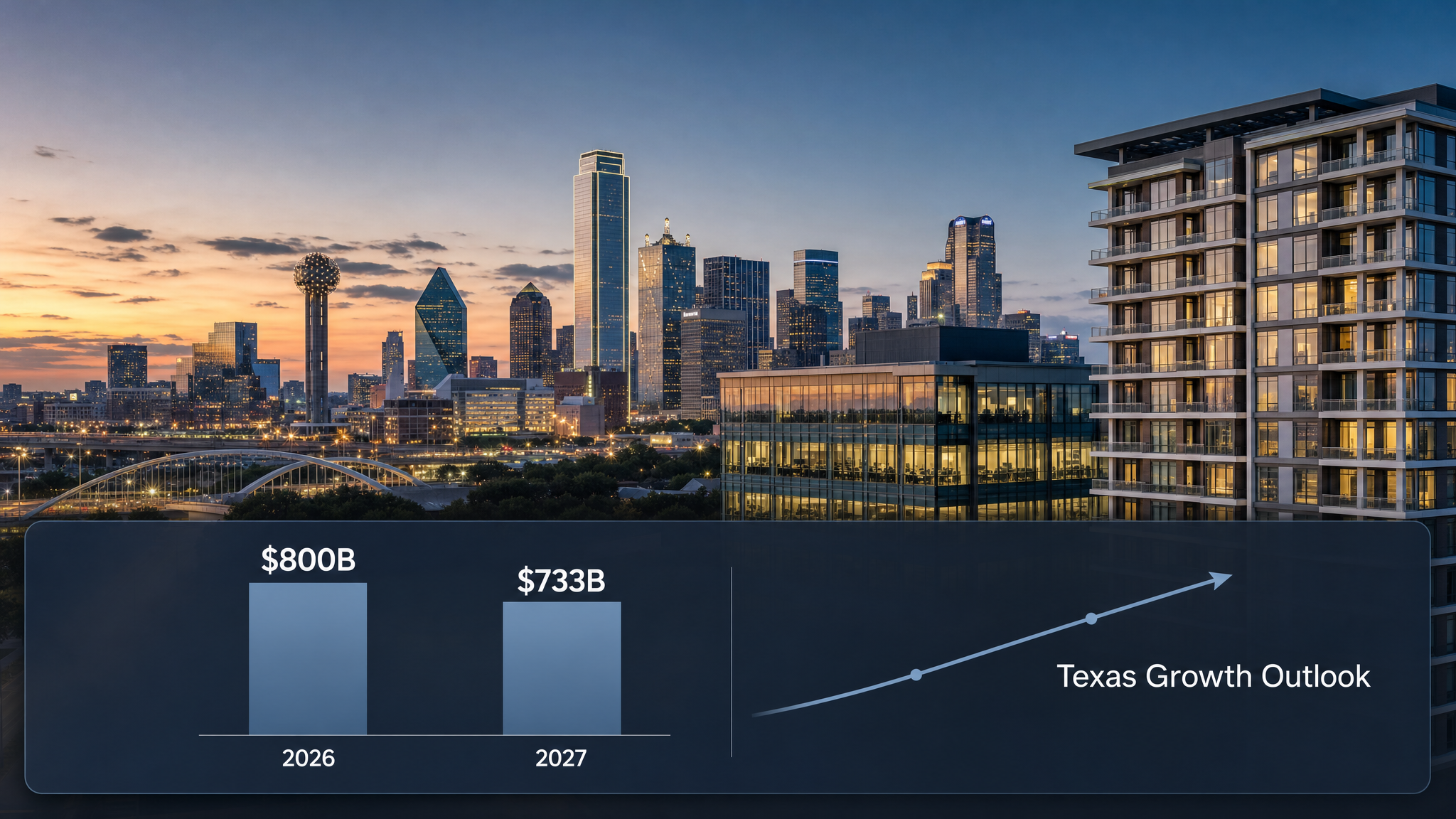
According to a recent CRE Daily report republished by Yahoo Finance, Trepp estimates $733.2 billion of commercial real estate loans will mature in 2027, following roughly $800 billion projected to mature in 2026. That is the so-called “debt wall.”
The issue is straightforward: a property financed at or near 4% may now need to refinance closer to double that rate. Higher debt service means the property supports a smaller loan. If the owner cannot make up the difference with new equity, a loan extension, a rescue-capital structure, or a sale may become necessary.
This is not just a spreadsheet issue. Financing changes affect pricing, renovation budgets, leasing decisions, and whether a property can trade at all.
Why Apartments Are Part of the Conversation
The Wall Street Journal recently highlighted the growing strain on apartment owners, reporting that America’s landlords face nearly $2 trillion in multifamily debt maturities over the coming decade. Much of the near-term challenge is tied to properties financed in 2021 and 2022, often with floating-rate debt and assumptions that rents and valuations would keep climbing.
Apartments are not a single market. A well-located, well-operated property with stable occupancy is not the same as a new, highly leveraged project facing heavy supply or soft rent growth. Still, the refinancing math is real, particularly for owners whose income did not grow as quickly as their debt costs.
Texas is directly exposed to that dynamic. The Yahoo Finance/CRE Daily report cites Trepp research showing $3.04 billion in Texas floating-rate loans across 130 performing apartment loans with debt-service coverage below 1.0x. That does not mean every one of those loans will default. It does mean lenders, borrowers, and buyers will be watching those assets closely.
What “Opportunity” Really Looks Like
It is tempting to assume that a debt wall automatically creates bargains. Real life is slower.
Sellers may extend loans, add equity, bring in a partner, or wait for better conditions. Buyers may see a discount but still struggle to secure financing at terms that justify the purchase. As the CRE Daily report notes, some unsigned transactions are repricing, while completed deals remain limited because sellers have not fully adjusted to today’s financing reality.
The opportunity, then, is not simply “buy distressed property.” It is to be prepared when a well-underwritten opportunity appears.
That preparation includes:
- Understanding the property’s true income after expenses, concessions, and capital needs.
- Stress-testing debt service at realistic refinance rates.
- Looking past a headline cap rate to the loan terms, maturity date, and required equity.
- Knowing the local supply pipeline and who the next tenant or buyer will be.
- Keeping enough liquidity to solve problems instead of creating new ones.
The Takeaway for North Texas Clients
There is no contradiction in believing Texas can remain a growth market while also recognizing that parts of commercial real estate are repricing.
In fact, that combination may create the next set of well-positioned opportunities: owners and buyers who understand their numbers, select markets carefully, and refuse to chase yesterday’s valuations.
For residential clients, the message is simpler: do not let national or commercial headlines make the decision for you. Your housing decision should be rooted in your payment comfort, your time horizon, and what is happening in your specific neighborhood.
For investors, developers, and commercial owners, the message is to get proactive. Review debt maturities early. Revisit assumptions. Know the difference between a temporary cash-flow issue and a structural financing problem. And when an opportunity comes to market, evaluate the asset—not just the discount.
Texas still has powerful long-term reasons to grow. The next 12 to 18 months will reveal which properties and ownership groups are built to grow with it.
This article is for general information only and is not financial, investment, legal, or tax advice. Real estate markets and financing terms vary materially by property and location.
Sources: Texas Real Estate Research Center at Texas A&M University, Texas Real Estate Forecast Through Summer 2027; The Wall Street Journal, Apartment Landlords Have a $2 Trillion Debt Problem That Is Only Getting Worse (subscription may be required); CRE Daily via Yahoo Finance, CRE Debt Wall: $733B Comes Due in 2027 as Extensions Fade.
Explore the full article archive
Browse more RJ Williams & Company articles on buyer strategy, seller guidance, broker responsibility, market updates, commercial real estate, land, investing, and new construction.